


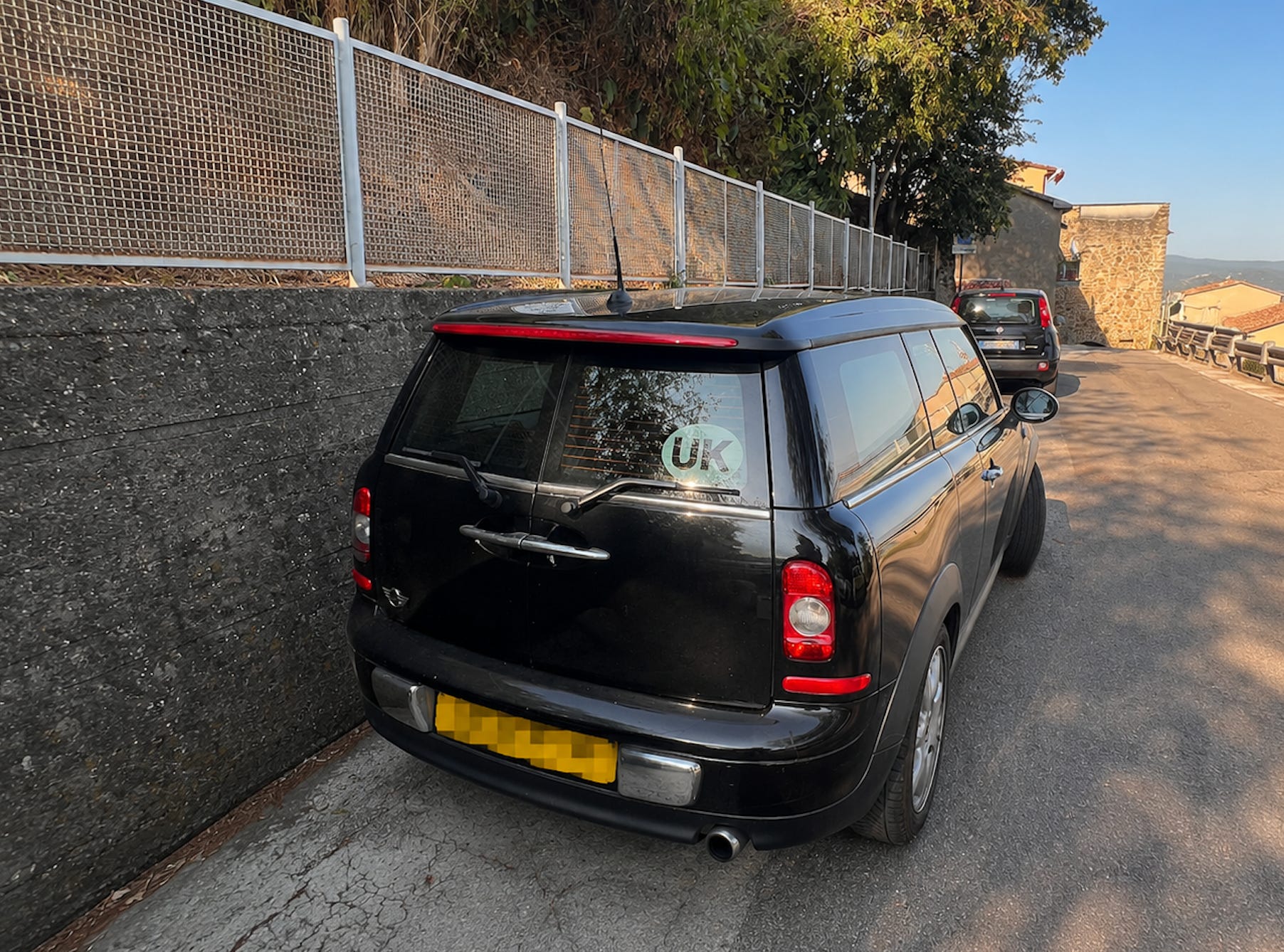
Dopo trent’anni all’estero, vivo da nomade tra Londra e diversi paesini italiani. Dove servo, vado. Con mia moglie - nonché mia capa - e una Mini targata UK che mi permette di osservare gli italiani quando sono convinti che io non li capisca.
La Mini è impareggiabile quando devi circolare in paesi costruiti secoli prima che qualcuno immaginasse l’automobile, tra vicoli larghi quanto una lavatrice e curve progettate evidentemente per un asino particolarmente magro.
Lo è un po’ meno quando, come la mia, è nera.
Lasciata sotto il sole italiano, smette rapidamente di essere un’automobile e diventa una friggitrice ad aria con targa britannica. La differenza principale è che, di solito, le patate entrano nella friggitrice per una missione gastronomica, io per puro masochismo.
Ha il volante a destra e quell’aria innocente da turista che non ha ancora capito dove possa parcheggiare. In questi mesi di onorato servizio è diventata qualcosa di più di un mezzo di trasporto: una specie di esperimento sociologico su quattro ruote.
Fuori dall’auto, la targa britannica suscita curiosità (le targhe tedesche e olandesi molto meno, quelle dell’est Europa sono invece al centro di polemiche di cronaca - tralascio). Le persone vogliono sapere da dove arrivo, come mai mi trovi lì, perché il volante sia dalla parte sbagliata e se a Londra piova davvero ogni giorno (fake news).
Sulla strada, invece, accade l’opposto.
L’asfalto è mio
Ho scoperto che una parte degli italiani diventa ancora più impaziente e aggressiva del solito quando pensa di avere davanti uno straniero. La targa inglese non concede attenuanti. Sembra piuttosto autorizzare una forma di xenofobia stradale.
Il messaggio, anche quando non viene pronunciato esplicitamente, è piuttosto chiaro: “L’asfalto è mio. Metti le tue ruote altrove. Qui non sai come si guida.”
Non importa necessariamente che tu abbia commesso un errore. Basta procedere con mezzo secondo di prudenza in più (provate voi a superare un trattore su una strada provinciale senza visuale!), esitare davanti a una precedenza creativa o non interpretare immediatamente una regola conosciuta soltanto dagli abitanti di quella specifica rotonda.
Un automobilista italiano può sbagliare. Uno straniero, invece, è la dimostrazione che gli stranieri non sanno guidare.
Impazienza, disperazione, clacson, gesti e insulti arrivano con una rapidità sorprendente. È una specie di bullismo territoriale: non sei soltanto un altro automobilista, ma qualcuno che sta occupando una strada che, nella testa di chi ti segue, gli appartiene personalmente dai tempi dei romani.
Tutto questo dura finché non ricambi gli insulti in italiano, possibilmente nelle parolacce che hai imparato nel dialetto locale. A quel punto la scena cambia.
Lo straniero che avrebbe dovuto subire in silenzio risponde perfettamente, spesso con una conoscenza del vocabolario locale più ampia del previsto. Per qualche secondo, dall’altra automobile arriva un’esitazione quasi percettibile: non eri la vittima che avevano immaginato.
Il volante dalla parte “sbagliata” aggiunge ulteriore confusione. Chi vuole insultare il conducente si rivolge quasi sempre a mia moglie, seduta a sinistra, cioè nel posto in cui dovrebbe trovarsi chi guida un’automobile italiana.
E mia moglie risponde, con la sicumera di un pirata della strada autoctono.
Da fuori deve sembrare una scena surreale: una donna apparentemente al volante che partecipa con entusiasmo allo scambio di cordialità vernacolare (con entrambe le mani), pur non avendo davanti né volante né pedali, mentre il vero conducente assiste dall’altra parte.
A quel punto non è più chiaro chi stia guidando, chi sia straniero e chi abbia insultato chi. Ma almeno diventa chiaro che abbiamo capito tutto.
“Noio volevam savoir... l'indiriss”
Girare per l’Italia con un’automobile britannica significa vivere l’esperienza come uno straniero. Ma nel mio caso assume un valore ulteriore, come un italiano undercover interessato agli aspetti sociologici dell’Italia su strada.
Un’osservazione: non tutti i poliziotti e i carabinieri decidono di verificare chi si nasconda davvero al volante di una macchina dalla targa gialla. Se fermi un, per esempio, belga, non importa se l’inglese è quello che è. Te la giochi alla pari. Ma con un inglese potrebbe metterti in imbarazzo.
Gli inglesi, nel 99.99% dei casi, non provano nemmeno a parlare italiano. Sono troppo sicuri del fatto che tutto l’Impero vittoriano sia ancora lì - ed esteso allo Stivale - e l’opera di evangelizzazione linguistica sia stata completata. Al massimo ti regalano un ‘Buongioooorno’ o un ‘Ciao’ e si aspettano un complimento per la fluenza linguistica.
A volte ho l’impressione che il pubblico ufficiale di turno faccia esattamente il contrario. Mi vede arrivare. Nota la targa britannica. Guarda il volante dalla parte sbagliata. Per un istante i nostri occhi quasi si incontrano. Poi gira il volto. Improvvisamente trova interessantissimo il paesaggio, controlla le proprie unghie, il telefonino oppure assume l’espressione assorta di chi sta mentalmente canticchiando una canzone.
Non sembra distratto. Sembra impegnatissimo a non guardarmi.
Forse, in quel momento, immagina già tutto ciò che potrebbe accadere fermandomi: i documenti britannici, la patente inglese, il conducente seduto dalla parte sbagliata, la moglie al posto del presunto guidatore e, soprattutto, il rischio che qualcuno abbassi il finestrino e cominci a fargli domande in inglese per chiedere indicazioni.
Meglio lasciar passare.
L’automobile è lì, è chiaramente straniera, ma se nessuno la guarda abbastanza a lungo forse non esiste.
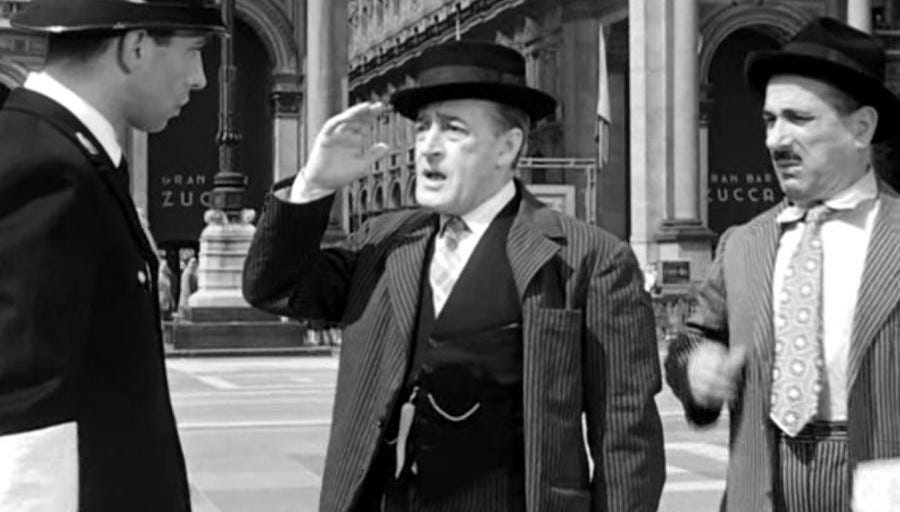
È una scena di Totò al contrario.
In Totò, Peppino e la… malafemmina sono gli italiani appena arrivati a Milano a tentare disperatamente di parlare una lingua straniera: «Noio volevam savoir…».
Qui, invece, sono io, il presunto straniero, che potrei fermarmi a chiedere informazioni, mentre il pubblico ufficiale sembra pensare:
Noio non volevam savoir proprio niente.
Così rallento, passo davanti alla pattuglia e per qualche secondo ci ignoriamo con grande professionalità. Io fingo di non avere bisogno di nulla. Lui finge di non aver visto la Mini. E insieme evitiamo una quantità considerevole di burocrazia e imbarazzo.
Patente e libretto. Ma non guido io!
Altri, invece, decidono di fermarmi.
La paletta si alza, io accosto e l’agente si avvicina automaticamente al lato sinistro della Mini. Mia moglie abbassa il finestrino.
«Patente e libretto.»
«Buongiorno, chiedo a mio marito, io non guido.»
A quel punto iniziano dieci o venti secondi di panico silenzioso.
L’agente guarda mia moglie. Mia moglie guarda l’agente. L’agente cerca il volante, non lo trova e, per un istante, sembra valutare l’ipotesi che la macchina sia arrivata fin lì autonomamente.
Poi guarda attraverso l’abitacolo e scopre me, seduto dall’altra parte, davanti al volante e con la patente già in mano.
Segue sempre un breve riavvio del sistema.
Non è colpa loro: ogni elemento della scena è al posto sbagliato. La persona a cui hanno chiesto la patente non guida. Quella che guida è seduta dove dovrebbe trovarsi il passeggero. La macchina è inglese, il conducente parla italiano e la passeggera, che sembrava la conducente, è anche mia moglie, la mia capa e ha già scaricato ogni responsabilità a me.
Io consegno i documenti.
L’agente controlla la targa britannica, guarda la patente inglese e poi guarda me. A essere onesti, di buona parte dei documenti che gli ho consegnato sembra capire poco. Controlla soprattutto la patente, probabilmente alla ricerca di qualcosa di familiare.
La situazione, del resto, non è semplicissima da riassumere: un italiano che guida in Italia una macchina inglese con una patente inglese.
Prima o poi arriva la domanda:
«Ma lei è italiano o inglese?»
Qualche volta ho avuto la tentazione di rispondere in inglese. Poi ho preferito evitare: non avevo voglia di scoprire se prendere in giro un pubblico ufficiale potesse trasformarsi in una denuncia. E, soprattutto, non se lo meritano.
La loro perplessità è comprensibile. In estate, con migliaia di stranieri sulle strade italiane, una Mini con targa britannica può passare quasi inosservata. Una Mini inglese in Puglia a gennaio è già meno ordinaria.
Se poi compare nel mezzo del Salento, di notte, diventa praticamente fermabilissima. In quelle circostanze mi fermerei anch’io, anche senza che me lo chiedessero, per autodenunciarmi preventivamente alle autorità.
Superati i documenti e stabilito che la Mini non è stata rubata a Londra poche ore prima, si apre generalmente il vaso di Pandora della curiosità.
Come mai siamo lì? Viviamo in Inghilterra? Dove stiamo andando? Perché abbiamo un’auto britannica in Italia? Come si guida con il volante a destra? È difficile sorpassare? E che cosa ci facciamo nel Salento a gennaio, di notte?
A quel punto il controllo di polizia si trasforma quasi in una conversazione al bar. Gli agenti si rilassano, noi raccontiamo una versione abbreviata della nostra vita nomade e, nel giro di pochi minuti, sembra quasi che qualcuno debba proporre un bicchierino di amaro. Anche se, tecnicamente, siamo tutti in servizio: loro come poliziotti e io come conducente.
Alla fine ci salutiamo cordialmente e ripartiamo.
Fino al controllo successivo, quando un altro agente si avvicina al lato sinistro, chiede la patente a mia moglie e tutto ricomincia dall’inizio.
Cinque gomme in sei mesi
I controlli non sono l’unica costante dei nostri viaggi. In sei mesi abbiamo bucato cinque gomme. Principalmente il fatto accade di notte e nel weekend. E la colpa, come in ogni impresa familiare, è di chi guida, non di chi, dalla sua posizione di capa, mi ha chiesto di prendere quella strada per andare a vedere qualcosa di non necessario.
Le strade italiane non sono esattamente il massimo per una Mini abituata ai 20 all’ora di Londra. Buche, rattoppi, tombini e improvvisi scavi archeologici (che fanno riaffiorare antiche strade romane intatte sotto le malconce strade statali della Repubblica del XXI secolo) trasformano ogni viaggio in una specie di videogioco nel quale le vite disponibili coincidono con il numero delle ruote.
La buona notizia è che i gommisti italiani costano una frazione di quelli inglesi e che non necessariamente ti vogliono vendere l’ultimo modello Michelin. Hanno sempre a disposizione un treno di gomme praticamente nuove probabilmente strappate al corpo esanime di un’altra mini inglese passata da quelle parti pochi giorni prima.
Le due cose, in qualche modo, si compensano.
In Inghilterra buchi raramente una gomma, ma devi accendere un mutuo per cambiarla. In Italia puoi distruggerne cinque e sentirti quasi un cliente privilegiato. Dovrei proporre loro una carta fedeltà. Non a caso ho finito per sviluppare con alcuni gommisti un rapporto più stabile di quello che ho con molte persone incontrate durante questi mesi. E al momento la mia macchina penso monti 4 marche diverse, un misto stagionale come la pizza 4 stagioni, e non mi curo nemmeno più del bilanciamento delle gomme. È come avere 4 impronte digitali diverse.
Yoga al casello
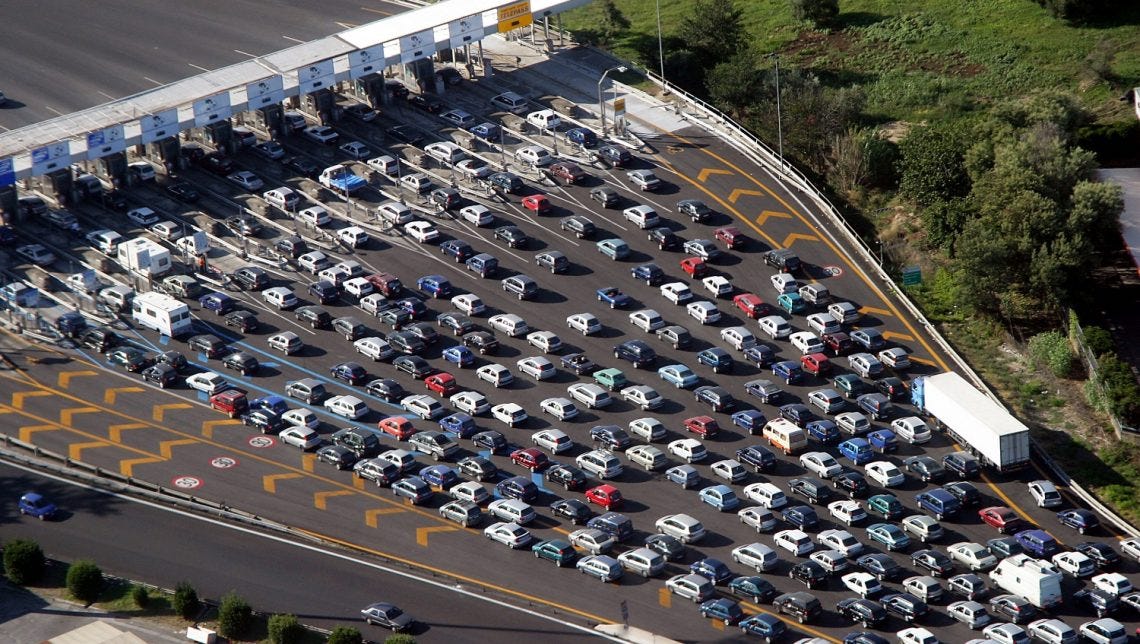
Per le autostrade, grazie a Dio, esiste il Telepass Grab&Go. Funziona ai caselli, in molti parcheggi e perfino per imbarcarsi su alcuni traghetti (non mi hanno pagato per questa menzione).
Nel mio caso non è soltanto una comodità tecnologica: è un presidio ortopedico.
Con il volante a destra, infatti, la colonnina del biglietto si trova dall’altra parte dell’auto. Le possibilità sono tre: viaggiare con una moglie (possibilmente la propria) seduta accanto, scendere dalla macchina e prendersi gli insulti del mondo intero oppure praticare una forma avanzata di yoga automobilistico.
Quest’ultima soluzione richiede di attraversare l’abitacolo con metà busto appoggiato sul cambio, un braccio teso verso la macchinetta e la dignità abbandonata qualche metro prima del casello.
Io, fortunatamente, viaggio con mia moglie. Che, oltre a essere la mia capa, è diventata anche responsabile dei biglietti, dei pedaggi, dei parcheggi e dei rapporti diplomatici con gli altri automobilisti.
Il Telepass ha poi un secondo vantaggio: non ti permette di capire immediatamente quanto hai speso. La sbarra si alza, senti un rassicurante bip e continui il viaggio con l’illusione che sia tutto normale. Anzi c’è una sorta di presunzione nell’avere il Telepass con una macchina straniera. Nessuno se lo aspetta e lo zero contegno di chi ti sfanalava a 300 metri dal casello a 150 all’ora si trasforma in un cenno di ‘Respect’ e in un ghigno condiviso per tutti i primitivi in coda.
Il costo esorbitante delle autostrade italiane arriverà più tardi, quando sarà ormai troppo tardi per tornare indietro. È una follia, ma almeno è una follia contactless.
Il tagliando obbligatorio a Londra
Poi c’è la paranoia amministrativa.
Ogni tot mesi dobbiamo rimetterci in viaggio e tornare verso Londra, per evitare che la nostra permanenza da una parte o dall’altra faccia scattare qualche misteriosa segnalazione legata alla residenza, all’automobile o all’assicurazione.
La sensazione è che l’Italia e il Regno Unito condividano una posizione molto chiara nei nostri confronti: nessuno dei due sembra particolarmente entusiasta di assicurarci, ma entrambi sarebbero felicissimi di tassarci.
Così il ritorno a Londra è diventato quasi una tappa di manutenzione obbligatoria.
Ogni certo numero di chilometri bisogna controllare le gomme, cambiare l’olio e riportare temporaneamente proprietari e automobile nel loro habitat burocratico di riferimento.
Non è un vero ritorno a casa. È più simile a un tagliando.
Risalire verso il Regno Unito serve a ricordare ai sistemi informatici britannici che esistiamo ancora e, possibilmente, a rassicurare quelli italiani sul fatto che non abbiamo intenzione di stabilirci clandestinamente in un parcheggio del Salento o della Maremma.
Poi, completato il rituale, possiamo ripartire.
Almeno fino alla prossima scadenza, al prossimo controllo o alla prossima lettera che inizia con “Gentile cliente” e finisce chiedendoci di dimostrare dove viviamo davvero.
Domanda alla quale, ormai, non sapremmo rispondere neppure noi.
Il ‘Giorno della marmotta’ al distributore
La parte migliore della settimana arriva quando mi fermo a fare benzina nei piccoli paesi.
Quasi sempre, accanto al distributore c’è un piccolo bar, e c’è un gruppo di anziani seduti a osservare il traffico. Dal benzinaio sono rigorosamente vecchietti maschi, davanti alle case, con le loro seggioline ci sono invece le vecchiette e la loro funzione di ZTL umanitaria. La Mini nera con targa britannica entra immediatamente nel loro palinsesto.
Appena mi fermo iniziano a discutere della “macchina al contrario”. Uno indica il volante dalla parte sbagliata. Un altro spiega agli altri come si guida in Inghilterra. A quel punto la conversazione si allarga inevitabilmente a Londra, alla pioggia, alla nebbia e al fatto che nel Regno Unito, secondo loro, il sole non si veda mai.
Io faccio benzina ascoltando in silenzio. Poi, prima di ripartire, li saluto in italiano.
Per qualche secondo nessuno parla.
Mi guardano come se fosse stata la Mini a rispondere. Quello che fino a un momento prima era un turista inglese è improvvisamente diventato un italiano che ha ascoltato tutto.
La cosa più straordinaria è che, dopo tre giorni, torno allo stesso distributore e la scena ricomincia identica.
La macchina al contrario. Londra. La pioggia. Il tempo inglese. Io che faccio benzina. Il saluto in italiano. Lo stupore.
È il Giorno della marmotta ambientato in un benzinaio di paese.
Non ho ancora capito se non si ricordino di me, se pensino che tutte le Mini inglesi siano uguali o se, semplicemente, ogni volta preferiscano ricominciare la storia dall’inizio.
Forse per loro non sono sempre lo stesso straniero. Forse sono una serie.
Lo straniero gode di qualche attenuante
La mia identità variabile funziona particolarmente bene nei piccoli paesi.
Se sono straniero, anche la domanda più ovvia viene accolta con pazienza. Se sono italiano e faccio esattamente la stessa domanda, lo sguardo cambia: non è più curiosità, ma una valutazione morale.
Come puoi non conoscere una regola che nessuno ti ha spiegato e che, evidentemente, sanno tutti?
Lo straniero può non sapere.
L’italiano avrebbe dovuto informarsi nel 1997. Ma io nel 1997 ero già emigrato e non posso sapere.
Fingersi straniero, quindi, ogni tanto può tornare utile.
Non parlo di grandi violazioni. Piuttosto di quelle piccole scappatelle quotidiane che, commesse da un italiano, provocano immediatamente una sentenza morale, mentre compiute da uno straniero possono essere attribuite alla confusione, alla lingua o a un navigatore particolarmente creativo.
In futuro penso di scrivere un articolo sulle scene di macchine enormi incastrate in stradine di paese perché “il navigatore mi ha detto di passare da questa parte”. Lascio l’argomento per un’altra occasione.
Lo straniero non è necessariamente innocente. È soltanto spaesato (la parola rende perfettamente l’idea).
La targa britannica, il volante a destra e un’espressione sufficientemente perplessa possono aiutare a ottenere qualche secondo di comprensione in più.
A volte basta indicare la strada, guardare il cartello e assumere l’aria di chi ha appena scoperto che in Italia esistono regole diverse da quelle del resto del pianeta.
Poi c’è la grande leggenda metropolitana secondo cui le multe italiane spedite all’estero non arriverebbero quasi mai. Per il momento, devo ammetterlo, la leggenda sembra aver funzionato.
Ma preferisco non metterla troppo alla prova.
Le leggende metropolitane sono affascinanti finché non si materializzano tutte insieme, con interessi e spese di notifica, nella cassetta delle lettere di Londra.
Straniero, ma non troppo
All’inizio pensavo che fingermi straniero potesse essere una comodità. Poi ho capito che la finzione era minima.
Dopo trent’anni all’estero non smetti di essere italiano. Diventi però italiano in un modo che, in Italia, non è immediatamente riconoscibile.
Conosci ancora la lingua, ma non sempre la punteggiatura sociale. Sai che cosa significa “ci sentiamo”, ma ogni tanto commetti l’ingenuità di aspettarti davvero una telefonata.
Ricordi le regole, ma nel frattempo ne sono state aggiunte altre, mai scritte e già considerate ovvie da tutti.
Non sono tornato definitivamente e non sto cercando di ricominciare la vita che avevo lasciato. Mi muovo tra Londra e l’Italia, tra città e paesi, tra il luogo in cui vivo e quelli in cui, temporaneamente, servo.
È una condizione strana: essere contemporaneamente di casa e in visita.
Abbastanza italiano da capire tutto ciò che si dice al distributore. Abbastanza straniero da stupirmene ancora.
Al bar sono italiano. Davanti a un modulo sono appena arrivato. Con un artigiano sono inglese e ho bisogno di una data precisa. Davanti a una pattuglia sono quello seduto dalla parte sbagliata. In autostrada lascio fare al Telepass.
E quando qualcuno insulta il conducente, risponde mia moglie dal posto del passeggero.
Che, del resto, è la capa.
Travelling around Italy as a foreigner. Or, more precisely, as an undercover Italian.
After thirty years abroad, I now live a nomadic life between London and a succession of small Italian towns and villages. Wherever I’m needed, I go, accompanied by my wife - who also happens to be my boss - and a UK-registered Mini that gives me the rather wonderful opportunity to observe Italians when they are absolutely convinced I cannot understand a word they are saying.
The Mini is unbeatable when you have to drive through places built centuries before anyone had even imagined the motor car, along lanes roughly the width of a washing machine and round bends apparently designed with an unusually skinny donkey in mind.
It is slightly less unbeatable when, like mine, it is black. Leave it under the Italian sun and it rapidly stops being a car and turns into an air fryer with British number plates; the main difference is that potatoes generally enter an air fryer in pursuit of a culinary purpose, whereas I climb into mine through sheer masochism.
It has the steering wheel on the right and the innocent expression of a tourist who still hasn’t worked out where he is allowed to park. After several months of honourable service, it has become something rather more than a means of transport: it is now a sort of sociological experiment on four wheels.
Away from the road, the British number plate inspires curiosity - German and Dutch plates considerably less so, while Eastern European ones are currently at the centre of various news controversies which I shall tactfully leave alone. People want to know where I come from, what on earth I’m doing there, why the steering wheel is on the wrong side and whether it really rains every single day in London. Fake news, incidentally.
On the road, however, the effect is quite different.
The tarmac is mine
I have discovered that a certain proportion of Italians become even more impatient and aggressive than usual when they believe the person in front of them is foreign. A British number plate earns you no leniency; if anything, it seems to authorise a peculiar form of roadgoing xenophobia.
The message, even when nobody actually says it out loud, is fairly obvious: “The tarmac is mine. Take your wheels somewhere else. You don’t know how to drive here.”
You do not necessarily have to make a mistake. It is enough to drive with half a second more caution - and I invite anyone to try overtaking a tractor on a country road with absolutely no visibility - hesitate at a creatively interpreted right of way, or fail to understand immediately a rule apparently known only to the inhabitants of that particular roundabout.
An Italian driver is allowed to make a mistake; a foreign driver, by contrast, becomes living proof that foreigners simply cannot drive.
Impatience, despair, horns, hand gestures and abuse arrive with astonishing speed. It is a sort of territorial bullying in which you are no longer merely another motorist, but an intruder occupying a stretch of road that, in the mind of the person behind you, has belonged personally to his family since Roman times.
All of this continues until you return the abuse in Italian, preferably using the swear words you have picked up in the local dialect, at which point the scene changes rather dramatically. The foreigner who was expected to endure everything in silence answers back perfectly, often displaying a considerably broader local vocabulary than anticipated, and for a few seconds there is an almost perceptible hesitation from the other car: you were not quite the victim they had imagined.
The steering wheel being on the “wrong” side adds another layer of confusion, because anyone wishing to insult the driver almost invariably addresses my wife, who is sitting on the left - exactly where the driver of an Italian car ought to be.
And my wife answers, with all the supreme confidence of a fully indigenous road pirate.
From outside, the scene must look fairly surreal: a woman who appears to be driving enthusiastically participating in an exchange of vernacular pleasantries - often with both hands - despite having neither steering wheel nor pedals in front of her, while the actual driver watches from the other side.
By that stage, it is no longer entirely clear who is driving, who is foreign, or who insulted whom, but at least everybody understands that we understood everything.
“Noio volevam savoir… l’indiriss”
Driving around Italy in a British car means experiencing the country as a foreigner, although in my case there is an extra dimension to it: I am effectively an Italian undercover, with a particular interest in the sociology of Italy as observed from the road.
One thing I have noticed is that not every police officer or carabiniere seems particularly keen to discover who is actually hiding behind the wheel of a car with a yellow number plate. Stop, say, a Belgian and it doesn’t really matter if your English is less than perfect; linguistically, you are probably starting on fairly equal terms. Stop an Englishman, on the other hand, and things have the potential to become awkward.
The English, in 99.99 per cent of cases, do not even attempt to speak Italian. They remain deeply confident that the Victorian Empire is still fully operational, has somehow been extended to the Italian peninsula and that the linguistic conversion of the natives was successfully completed some time ago. At most, they will offer you a heroic “Buongioooorno” or “Ciao” and then wait expectantly for praise of their astonishing fluency.
Sometimes I get the impression that the officer on duty has made the same calculation. He sees me approaching, notices the British number plate, registers the steering wheel on the wrong side and, for a fleeting moment, our eyes almost meet before he looks away. Suddenly the surrounding landscape becomes extraordinarily interesting; he checks his fingernails, studies his phone or acquires the contemplative expression of a man silently humming a song to himself.
He does not look distracted so much as intensely committed to not looking at me.
Perhaps he is already imagining everything that might happen if he stops us: the British documents, the British driving licence, the driver sitting on the wrong side, the wife sitting where the presumed driver ought to be and, worst of all, the risk that somebody may lower a window and begin asking him for directions in English.
Better to let us through.
The car is there and it is unmistakably foreign, but perhaps if nobody looks at it for long enough, it ceases to exist. It is a Totò sketch in reverse.
In Totò, Peppino e la… malafemmina, it is the Italians newly arrived in Milan who desperately attempt to speak a foreign language with the immortal: “Noio volevam savoir…”
Here, instead, I am the presumed foreigner who might conceivably stop and ask for directions, while the officer seems to be thinking: Noio non volevam savoir proprio niente.
So I slow down, drive past the patrol car and, for a few moments, we ignore one another with enormous professionalism: I pretend I need nothing, he pretends he has not seen the Mini, and together we avoid a considerable quantity of paperwork and embarrassment.
Driving licence and registration. But I’m not driving!
Others, of course, do decide to stop me.
The paddle goes up, I pull over and the officer automatically walks towards the left-hand side of the Mini, where my wife lowers the window.
“Driving licence and registration.”
“Good morning. I’ll ask my husband - I’m not driving.”
What follows is usually ten or twenty seconds of silent panic, during which the officer looks at my wife, my wife looks at the officer, and the officer searches for the steering wheel, fails to find it and, for one brief moment, appears to consider the possibility that the car may somehow have arrived there under its own power.
Then he looks across the cabin and discovers me sitting on the other side, behind the steering wheel, already holding my licence. There is invariably a short system reboot.
It is not their fault, because every element of the scene appears to be in the wrong place. The person they have asked for the driving licence is not driving; the person who is driving is sitting where the passenger ought to be; the car is British, the driver speaks Italian and the passenger, who looked like the driver, is also my wife, my boss and has already transferred all responsibility firmly in my direction.
I hand over the documents and the officer studies the British registration, examines my British driving licence and then looks at me. To be fair, he often seems to understand relatively little of some of the paperwork I have just given him, concentrating mainly on the licence, presumably in the hope of finding something reassuringly familiar.
The situation is, admittedly, not especially straightforward to summarise: an Italian driving a British car in Italy on a British driving licence.
Sooner or later, the inevitable question arrives: “So, are you Italian or English?”
A few times I have been tempted to answer in English, but I have always thought better of it, partly because I have no particular desire to discover whether taking the piss out of a public official can somehow evolve into a criminal complaint and, more importantly, because they really do not deserve it.
Their confusion is perfectly understandable. In summer, with thousands of foreign cars on Italian roads, a British Mini can almost disappear into the scenery; a British Mini in Puglia in January is already rather more conspicuous, and if it appears in the middle of Salento at night it becomes virtually impossible not to stop.
Under those circumstances, I would probably pull myself over even if nobody asked, purely to make a pre-emptive declaration to the authorities.
Once the documents have been checked and it has been established that the Mini was not stolen in London a few hours earlier, Pandora’s box of curiosity normally opens. Why are we there? Do we live in England? Where are we going? Why do we have a British car in Italy? What is it like driving with the steering wheel on the right? Is overtaking difficult? And, above all, what on earth are we doing in Salento in January, at night?
At that point, the police check gradually turns into something approaching a conversation at the bar. The officers relax, we tell them an abbreviated version of our nomadic life and, within a few minutes, it begins to feel as though somebody ought to be offering a small glass of amaro, even though technically we are all still on duty: they as police officers and I as the driver.
Eventually we say goodbye warmly and set off again, at least until the next checkpoint, when another officer approaches the left-hand window, asks my wife for her driving licence and the entire process begins again.
Five tyres in six months
Police checks are not the only recurring feature of our travels: in six months, we have punctured five tyres, usually at night and preferably at the weekend. And naturally, as in every well-run family business, the blame belongs entirely to the person driving rather than to the boss who, from the comfort of the passenger seat, instructed him to take that particular road because there was something completely unnecessary she wanted to go and see.
Italian roads are not exactly ideal territory for a Mini accustomed to London’s 20mph limits. Potholes, patches, manhole covers and unexpected archaeological excavations - occasionally revealing beautifully preserved Roman roads beneath the rather less well-preserved state roads of the twenty-first-century Republic - turn every journey into a video game in which your available lives correspond roughly to the number of wheels.
The good news is that Italian tyre fitters cost a fraction of their British counterparts and, even better, they do not automatically attempt to sell you the latest Michelin model. They invariably seem to have a nearly new tyre available somewhere out the back, quite possibly torn from the lifeless body of another British Mini that passed through the area several days earlier.
Somehow, the two things balance each other out.
In Britain, you rarely puncture a tyre but practically need a mortgage to replace it; in Italy, you can destroy five and begin to feel like a valued customer. I should really suggest a loyalty card, particularly as I have now developed more stable relationships with several tyre fitters than with many of the people I have met during these months.
At the moment, I am fairly sure my Mini is wearing four different brands of tyre, with a seasonal mix reminiscent of a quattro stagioni pizza, and I no longer trouble myself too much about balancing. It is rather like driving around with four different fingerprints.
Yoga at the toll booth
For motorways, thank God, there is Telepass Grab&Go. It works at toll booths, in many car parks and even for boarding certain ferries - and no, they have not paid me for this mention.
In my case, it is not merely a technological convenience but an orthopaedic device, because with the steering wheel on the right, the ticket machine is naturally on the opposite side of the car.
There are three possible solutions: travel with a wife - ideally your own - sitting beside you, get out of the car and absorb the abuse of the entire motoring population behind you, or perform an advanced form of automotive yoga.
The last option involves stretching yourself across the cabin with half your torso resting on the gear lever, one arm reaching desperately towards the machine and your dignity abandoned several metres before the toll booth.
Fortunately, I travel with my wife, who, in addition to being my boss, has become responsible for tickets, tolls, parking and diplomatic relations with other motorists.
Telepass offers another significant advantage: it prevents you from immediately understanding how much money you have spent. The barrier rises, you hear a reassuring beep and continue your journey under the comforting illusion that everything is perfectly normal.
There is also a faint but undeniable swagger involved in having Telepass in a foreign car. Nobody expects it, and the man who was flashing his headlights at you from 300 metres away while approaching the toll booth at 150 kilometres an hour suddenly abandons all hostility and gives you a small nod of Respect, followed by a conspiratorial grin directed at all the primitives queuing for tickets.
The spectacular cost of Italian motorways will reveal itself later, when it is far too late to reconsider your route. It is madness, certainly, but at least it is contactless madness.
The compulsory London service
Then there is the administrative paranoia.
Every few months we have to get back on the road and head towards London, lest spending too long on one side or the other trigger some mysterious alert connected with residency, the car or the insurance.
The general impression is that Italy and the United Kingdom have arrived at a remarkably similar position regarding our existence: neither is particularly enthusiastic about insuring us, but both would be absolutely delighted to tax us.
As a result, returning to London has become something close to a compulsory maintenance stop. After a certain number of miles, you check the tyres, change the oil and temporarily return both vehicle and owners to their bureaucratic habitat of origin.
It is not really going home so much as taking ourselves in for a service.
Heading back to Britain serves to remind British computer systems that we still exist and, ideally, reassure the Italian ones that we have no intention of secretly establishing permanent residence in a car park somewhere in Salento or the Maremma.
Once the ritual has been completed, we can set off again until the next deadline, the next police check or the next letter beginning with “Dear Customer” and ending with a request that we prove where we actually live — a question which, by now, even we would struggle to answer.
‘Groundhog Day’ at the petrol station
The best part of the week comes when I stop for petrol in small towns and villages.
There is almost always a tiny bar beside the petrol station, and outside it sits a group of elderly men whose principal occupation appears to be observing passing traffic. At petrol stations they are invariably old men; outside houses, on little chairs, you find the elderly ladies instead, operating a sort of human ZTL - Italy’s low-traffic zone system, only with more effective enforcement.
The black Mini with British plates immediately enters the day’s programming.
As soon as I stop, they begin discussing “the backwards car”. One points out the steering wheel on the wrong side, another explains to the group how driving works in Britain, and from there the conversation inevitably expands to London, rain, fog and their absolute certainty that nobody in the United Kingdom has seen the sun since approximately 1973.
I fill up while listening silently, then, just before leaving, I say goodbye to them in Italian.
For a few seconds, nobody says anything. They stare at me as though the Mini itself has suddenly spoken, because the man who, until a moment earlier, was simply an English tourist has unexpectedly turned into an Italian who has heard absolutely everything.
The truly extraordinary part is that I can return to the same petrol station three days later and the entire scene will begin again: the backwards car, London, the rain, the English weather, me filling up, the farewell in Italian and the astonishment.
It is Groundhog Day, except set at a village petrol station.
I still cannot work out whether they simply do not remember me, whether they believe all British Minis look identical or whether they just prefer to restart the story from the beginning each time. Perhaps, in their minds, I am not always the same foreigner.
Perhaps I am a series.
Foreigners are allowed a little leeway
My variable identity works particularly well in small towns and villages.
If I am foreign, even the most obvious question tends to be met with patience; if I am Italian and ask exactly the same thing, the expression changes and what was curiosity becomes something closer to moral judgement.
How can you possibly not know a rule nobody has ever explained to you and which, apparently, everyone else has always known?
A foreigner is allowed not to know; an Italian should have found out in 1997, although in my defence I had already emigrated by then and therefore had no reasonable way of knowing.
Pretending to be foreign can consequently prove rather useful from time to time.
I am not talking about major offences, but those tiny everyday transgressions which, when committed by an Italian, immediately provoke a moral verdict, whereas in the case of a foreigner they can be attributed to confusion, language difficulties or a particularly imaginative satnav.
At some point I intend to write an entire article about enormous cars becoming wedged in tiny village lanes because “the satnav told me to come this way”, but I shall save that for another occasion.
The foreigner is not necessarily innocent; he is simply spaesato - disorientated, out of place, slightly lost, although the Italian word captures it rather better.
British number plates, a steering wheel on the right and a sufficiently bewildered expression can buy you a few extra seconds of understanding. Sometimes all you have to do is point towards the road, stare thoughtfully at the sign and adopt the expression of someone who has only just discovered that Italy operates according to rules entirely different from those governing the rest of the planet.
Then there is the great urban myth that Italian fines sent abroad almost never arrive and, so far, I have to admit that the myth appears to be holding up rather well.
I would nevertheless prefer not to test it too enthusiastically, because urban myths are charming things until they all materialise simultaneously in your London letterbox, complete with interest and notification charges.
Foreign, but not too foreign
At first, I thought pretending to be foreign might simply be convenient; eventually, I realised that there was very little pretending involved.
After thirty years abroad, you do not stop being Italian, but you do become Italian in a way that is no longer immediately recognisable in Italy.
You still know the language, although you do not always understand its social punctuation. You know perfectly well what ci sentiamo means, but every now and then you still make the rather naïve mistake of expecting an actual phone call.
You remember the rules, except that in the meantime new ones have been added - never written down anywhere, yet already treated by everybody as self-evident.
I have not moved back permanently and I am not attempting to restart the life I left behind. I move between London and Italy, between cities and villages, between the place where I live and the places where, temporarily, I am needed.
It is an odd condition: being simultaneously at home and a visitor, Italian enough to understand everything being said at the petrol station yet foreign enough still to be surprised by it.
At the bar I am Italian; faced with a form, I have only just arrived. With a tradesman, I am English and require an exact date; at a police checkpoint, I am the man sitting on the wrong side; on the motorway, I leave everything to Telepass.
And when somebody insults the driver, my wife answers from the passenger seat.
Which is fair enough, really.
She is the boss.
Molto divertente.
E purtroppo la dice lunga sul "senso dello straniero" per noi Italiani